
MILT THOMAS
Did you ever wonder what it is like to suffer from dementia? Not that anyone would want to, but if you knew how this debilitating affliction can change the life of a loved one, you might better understand how to deal with it. And chances are fairly good you will deal with it at some point in your lives, either with a parent, or spouse or yourselves.
You can go to a place right here in Vero Beach and experience what it is like to have the illness by taking a Virtual Dementia Tour. No, this is not an Edgar Allen Poe theme park. It is a service provided at the Center for Memory and Motion in the offices of the Alzheimer and Parkinson Association of Indian River County located at 2300 5th Avenue, Suite 150.
According to Executive Director Peggy Cunningham, “It is important for caregivers or potential caregivers to know what the sufferer is dealing with, so that’s why we developed the Virtual Dementia Tour.”
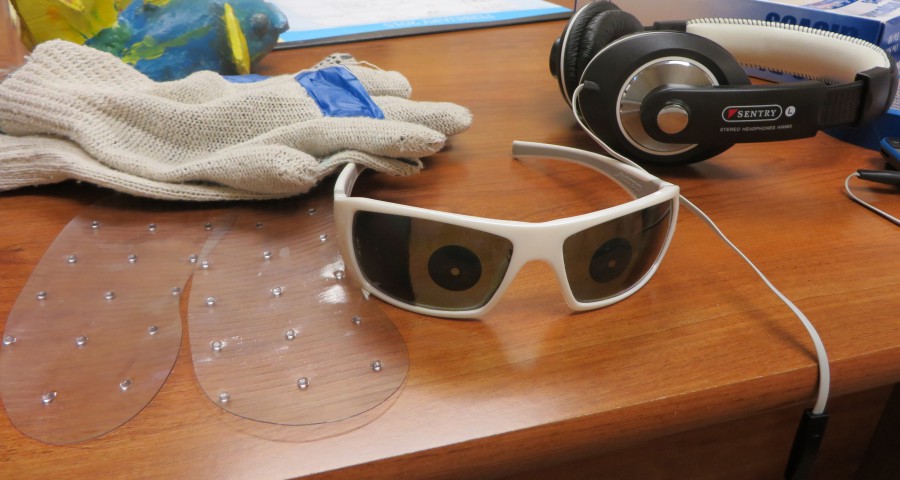
The “tour” starts with preparing your body with the kinds of afflictions normally found in the elderly who are most likely to suffer from dementia. To prepare, you first place plastic inserts in your shoes so your feet rest on tiny projections that simulate walking on “pins and needles.” Then you slip on thick workman-style gloves with the first two fingers taped together on one hand as well as the last three finger on the other. Goggles cover your eyes with the center of vision blacked out to simulate macular degeneration. Next you don ambient noise headphones with voices in the background along with an occasional train horn or fire truck.
Once this equipment is in place, you walk into a partially lit room where a strobe light flashes constantly and you are given simple instructions: fold towels among clothing in a laundry basket, sit down and write two two-sentence letters, put them in an envelope and seal, set a table for three people, pour water from a partially-obstructed container and put on a necktie. All of this must be completed in seven minutes.
After you are finished, your physical restrictions are removed. Some will bother you more than others, maybe all of them. With the goggles removed, you realize how poor a job you did with the tasks. More importantly, you will have forgotten most of the simple instructions. Cunningham says, “This is the everyday world of someone suffering from dementia.”
Dementia is actually an umbrella of symptoms that can include Alzheimer’s, forgetfulness, depression, stress, headaches, and many others. But the facts are startling: five million Americans suffer from dementia; almost two-thirds are women. Every 67 seconds an American develops Alzheimer’s or other form of dementia.
“The effect on loved ones of those suffering from dementia is also staggering,” says Cunningham. “In 2013, 15.5 million family and friends provided 17.7 billion (with a “b”) hours of unpaid care to those with the dementia. Nearly 60 percent of caregivers suffer high emotional stress, one third report symptoms of depression.”
Cunningham describes the difference between everyday forgetfulness, which seems to increase with age, and dementia. “If you go to the refrigerator and can’t remember why, that’s no a problem. But if you can’t remember what a refrigerator does, you need to see a neurologist.”
The Alzheimer and Parkinson Association of Indian River County started in 1982. It is unrelated to the national organization and this change in name of their facility to Memory and Motion Center is meant to emphasize that they are a support group, not a medical organization. Within the Center, people who suffer from these afflictions come to participate in a variety of activities designed to address their symptoms. “We refer to it as ‘the club,’” says Cunningham, “because they come here just to have fun, not treatment.”
Next Tuesday, March 26, the Center for Memory and Motion will host the tenth annual Day of Hope Caregiver Conference to be held at the First Presbyterian Church, 520 Royal Palm Blvd. It is a one day event open to caregivers and families of those suffering from dementia caused by Alzheimer’s disease or other neurological disorders. The program is designed to equip caregivers with knowledge and strategies to sustain the best quality of life as they care for someone with dementia.
The conference will feature two speakers in the field of Alzheimer and dementia related care, Pharmacology research expert and CEO of the University of South Florida Health Byrd Alzheimer Institute, Dr. David G. Morgan; and Laura Zel Kremer, a Licensed Clinical Social Worker from MorseLife Care Management and Counseling. The conference begins at 10:00 a.m., continues until 2:00 p.m. and a catered lunch is provided.
To make a reservation for Day of Hope or for more information on resources, programs or volunteering, email info@alzpark.org or call 772-563-0505.
 Indian River Guardian