
COMMENTARY
“While Mayfield, the Indian River County Commission, the Shores Town Council, the Tea Party, and local utility activists are wasting their time, energy and treasure pursing a hopeless dream, at least four members of the Vero Beach City Council are facing reality and fulfilling their responsibility to govern.”
MARK SCHUMANN
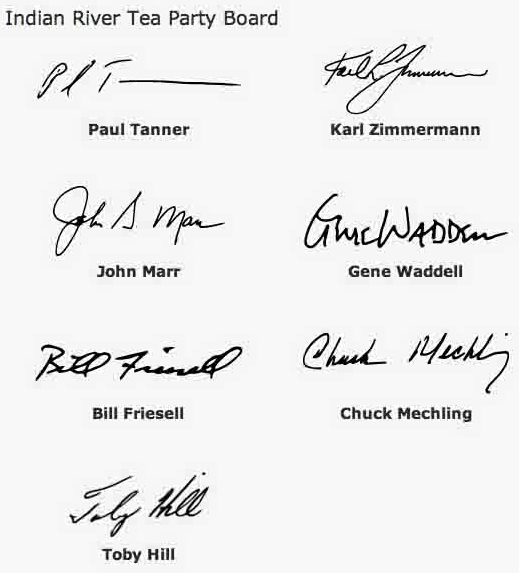 As a group, the Indian River Tea Party leadership is about as homogenious as the Indian River Shores Town Council, or the Indian River County Commission – all white, all male, largely privileged.
What’s troubling these well-to-do, upper middle aged white men these days? Certainly not unreasonably high import taxes on tea, growing income disparity, much-needed education reform, or the plight of a shrinking middle class. No, the protest group known as the Tea Party has come a long way from its heroic birth in Boston Harbor in 1773.
Nationally, the modern Tea Party was co-opted by big business interests. As a consequence, the movement drifted far from its initial objective of raising legitimate concerns about out-of-control government spending.
Locally, the Indian River Tea Party is dominated by real estate and development interests. For reasons that may have to do with opening waterfront land for future development, the group’s leadership seems keen on furthering Florida Power & Light’s efforts to expand its customer base by bringing down municipal power.
The group invests relatively little energy addressing wasteful spending by the Indian River County Commission. But when it comes to doing FPL’s bidding, the local Tea Party is, as they say, “all in.”
In joining the statewide battle over public power, local Tea Party leaders this week sent a letter to other Tea Party groups across the state. The letter claims customers of Vero Electric are the victims of “taxation without representation.”
Echoing the Indian River Shores Town Council’s legal claims, the local Tea Party’s argument seems to be that any rate above FPL’s current charge is unreasonable. The Tea Party’s statewide appeal, however, did not mention that a number of regulated investor-owned utilities currently charge rates higher than many of the state’s municipal utilities.
As a group, local Tea Party leaders are largely pro-sale fundamentalists. They support the sale of Vero Electric no matter the ultimate cost to the City of Vero Beach or to the larger community.
With the power sale all but dead, pro-sale fundamentalists are desparate. Their appeal for yet another audit of the FMPA, their meddling in local election across the state, their calls for dismantling the FMPA, and their pie-in-the-sky hopes of passing an amendment to the Florida Constitution to bring down the FMPA are little more than sound, fury and hot air.
Just as with the $2 million a previous City Council (Tracy Carroll, Craig Fletcher and Pilar Turner) spent negotiating a fatally flawed sales agreement between Vero Beach and FPL, these latest efforts to force the sale will come to nothing.
Bring up the issue of regulating the FMPA, or auditing the agency yet again, or devising some way to abrogate the FMPA’s commitments to bond holders, and many state legislators today will say, “That’s Mayfield’s issue. She needs to solve it locally.”
For three years running, State Representative Debbie Mayfield has proposed and failed to pass legislation intended to force the FMPA to set aside its contracts in order to make possible the sale of Vero Electric to FPL. This year, not a single one of Mayfield’s utility bills got so much as a hearing in committee.
More and more leaders from across the state are wising up to the fact that Vero Beach is being used as a pawn in FPL’s efforts to expand its customers base by taking on the FMPA. In truth, Mayfield, the members of the County Commission and the Indian River Shores Town Council, along with a number of utility activists, are, themselves, little more than pawns on FPL’s chess board.
With more state leaders seeing the larger picture, hopes of legislative intervention to force the sale of Vero Electric to FPL are fading, which is why some are resorting to acts of desparation.
In a recent “Utility Update,” the malcontent of the south barrier island, Dr. Stephen Faherty, called for the defeat of every member of the Vero Beach City Council, save Pilar Turner.
Ironically, Faherty is nearly as concerned with unregulated short-term rentals as he is with utility rates. Yet, Faherty is calling for the defeat of the very members of the City Council who have been willing to risk a court battle to preserve the city’s right to protect its neighborhoods.
Another utility activist, Charlie Wilson, now claims some unnamed “we” is prepared to spend $2 million to promote a ballot initiative to force the dissolution of the FMPA through an amendment to the Florida Constitution. Any such group will have to register with the state as a political committee, and will have to report its contributions and expenses. It would not be surprising to see FPL bankroll the effort, or to see Wilson listed as a paid consultant.
While Mayfield, the Indian River County Commission, the Shores Town Council, the Tea Party, and local utility activists are wasting time, energy and treasure pursing a hopeless dream, at least four members of the Vero Beach City Council are facing reality and fulfilling their responsibility to govern.
Unwilling to live in a fantasy land, they seem determined to do what can be done to lower electric rates. Just this week, the Council heard from special utility counsel, Schef Wright, on the status of negotiations to restructure Vero Beach’s wholesale power agreement with the Orlando Utilities Commission.
According to Wright, a new bulk power agreement, along with several other moves the City can take to lower rates, including decommissioning the power plant, could significantly narrow the rate differential between Vero Electric and FPL.
Fortunately for the customers of Vero Electric and for the resident of Vero Beach, the current city council remains focused on preserving and improve quality of life, working collaboratively with other municipalities, and planning for the future. Let’s hope that, despite all the sound a fury, they will be able to keep the main thing the main thing.
 Indian River Guardian