
Questions raised about County’s wastewater facility as brine contaminated water goes unaccounted for
COMMENTARY
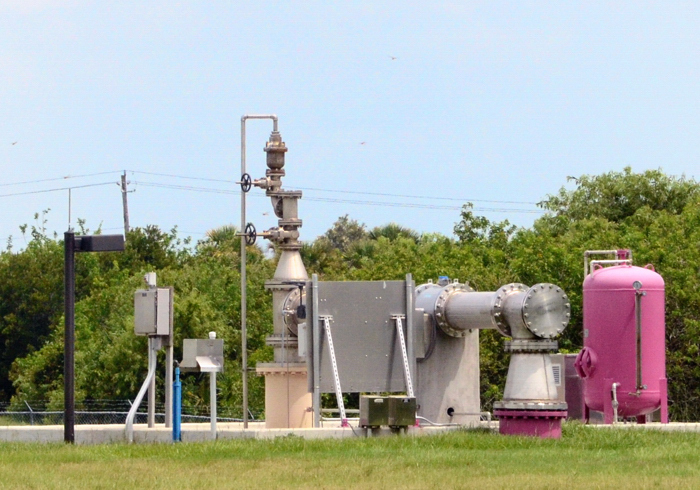
“Given that the City’s deep injection well is capable of disposing of ten times more brine per day than Spoonbill Marsh, it was more that a little misleading for the island weekly to write, ‘Officials (County) stand by their choice in 2009 to spend $4 million on the project (Spoonbill Marsh) instead of drilling a deep-injection well which could have cost utility ratepayers two to three times more.'”
Editor’s note: This article was first published in February, 2015. Given that County Commissioner Bob Solari is in a campaign mailer claiming personal credit for Spoonbill Marsh, questions about the effectiveness of the County’s wastewater treatment are again in the public eye.
MARK SCHUMANN
In a glowing article that read as if it had been written by public relations consultants, the island weekly recently reported that the County’s Spoonbill Marsh project provides “a net benefit to the lagoon.” While the County may deserve credit for trying an innovative approach to reducing brine discharge into the Lagoon, the assertion that Spoonbill Marsh is a cost-efficient way of disposing of concentrated brine seem dubious at best.
Spoonbill Marsh, a $4 million dollar, manmade wetlands north of Grand Harbor, was built to filter brine, a salt-heavy byproduct of the County’s reverse-osmosis plant. Brine is toxic to fish, and thus deadly to the Lagoon. Brine, diluted with water pumped from the Lagoon, flows through Spoonbill Marsh and then into two ditches emptying into the Lagoon.
Spoonbill Marsh was designed to receive 1 million gallons of brine a day to be mixed with 2.5 million gallons of Lagoon water. According to Indian River County Utilities Director Vincent Burke, the County is permitted to operate the project at two-thirds capacity. Event at full capacity, Spoonbill Marsh is a far more expensive means of disposing of brine than is the City’s deep injection well, which was built for $11 million and can handle 10 million gallons a day.
According to Vero Beach Water and Sewer Utility Director Rob Bolton, the City’s deep injection well, located east of the airport, was actually built for $6.5 million and could, as currently permitted, handle up to 10 million gallons of brine water a day. And additional $4.5 million was spent connecting the well to the waste water treatment plant. Bolton said that, if necessary, City’s deep injection well could be permitted to handle closer to 20 million gallons a day.
Given that the City’s deep injection well is capable of disposing of ten times more brine per day than Spoonbill Marsh, it was more that a little misleading for the island weekly to write, “Officials (County) stand by their choice in 2009 to spend $4 million on the project (Spoonbill Marsh) instead of drilling a deep-inhjection well which could have sot utility ratepayers two to three times more.”
In truth, the City spent $650,000 per 1 million gallons of disposal capacity, while the County spend $4 million per 1 million gallons. In terms of initial investment for capacity, Spoonbill Marsh cost six times as much as did the City’s deep injection well.
Spoonbill Marsh is also more expensive to operate. According to Burke, his budget for operating Spoonbill Marsh is $150,000 per year. In comparison, Bolton said the City spends $40,000 every five years on regular maintenance. Over the a decade, then, the County’s operating costs would be $1.5 million and the City’s $80,000. Unlike the County’s project, which requires pumping millions of gallons of water a day from the Lagoon into the marsh, the City’s brine water is already under pressure as it leaves the reverse opposite plant.
Is one project better than another? That point could be debated endlessly. Certainly the County deserves credit for innovating. City leaders, though, can hardly be faulted for investing in a deep-injection well that is clearly more cost-effective than Spoonbill Marsh.
What is not helpful is continued divisiveness, some of it fueled by the island weekly’s endless attacks on the City of Vero Beach.
Below is an article about Spoonbill Marsh written in 2007 by Richard Baker of the Pelican Island Audubon Society.
In order to cope with our county’s increase human population, Indian River County’s utilities department plans to add 6 more deep wells into the Floridian aquifer in the north county and another well in the south county. Before aquifer water is fit to drink, the salt must be removed by forcing the water through membranes, which leaves concentrated brine, which must be disposed of.
Very different than seawater, this brine is toxic to fish. As a result, the US Environmental Protection Agency has ordered the Florida Department of Environmental Protection, (DEP) to stop Indian River County from piping this concentrated brine directly into the Indian River Lagoon from their Reverse Osmosis plant.
To solve this waste brine disposal problem, the Indian River County Utility Department and their consultants have applied for a DEP permit to excavate 22 acres of fine upper salt marsh along our lagoon for the construction of settling ponds and ditches. Brine, diluted with water pumped in from the adjacent lagoon, will flow into 47 acres of mangrove forest and then into 2 ditches that empty into the Lagoon. The county’s own Chief Environmental Planner, Roland Dubois, described these coastal wetlands, now euphemistically called “Spoonbill Marsh”, and the related buffer uplands having HIGH ENVIRONMENTAL SIGNIFICANCE.
Why spend taxpayer money to damage one environmental marsh within the Indian River Lagoon Aquatic Preserve with designated Class II Outstanding Florida Waters and then spend more taxpayer’s money to repair another already damaged marsh?
Moreover, both the Army Corps of Engineers and the National Marine Fisheries Service (NOAA) previously determined the county’s plan would have a substantial adverse impact on essential fish habitat in the Indian River Lagoon. Why risk further ruination of our commercial and recreational fisheries with this ill-conceived venture?
The ramifications of this project are more than local, Humans are running out of potable water around the world. Our Audubon Board and scientists including the Florida’s Subcommittee on Managed Marshes are concerned that wetlands and estuaries around the country are being examined as potential RO wastewater dumping grounds. Indian River County could be setting a precedent for a major National battle particularly if wetlands and productive estuaries are impacted by RO effluent release.
Dr. Grant Gilmore, a world-class scientist, says the consultants did not adequately address site-specific hydrology, local plants and animals, dynamics, and function as there is so much previous work in local wetlands available. Gilmore did indepth studies of similar, adjacent wetlands at Grand Harbor in 1990-1994. The county and their consultants also ignored all the valuable regional local fishery species that their project will impact directly.
If this project must go through, we strongly suggest that the County:
- Involve the scientific community and especially consider Gilmore’s Grand Harbor 1990-94 study.
- Evaluate all the valuable regional local fishery species that the project will impact directly.
- Consider other less sensitive sites or ones already used for mitigation. Why not an inland site as suggested by the National Marine Fisheries Service?
- This project is estimated to cost $4 million to build. Set aside long term additional finances toindependently monitor the project to determine long-term effects. Such critical research is not easy as it involves counting fish, birds, dolphins on an annual basis and continuously measuring water quality, as well as determining what is happening to animals, plants, and microorganisms down the food chain, and most important, evaluation of high marsh and mangrove substrates. Or will it be simply left to future generations to discover the negative impact on these variables once it’s too late to do anything about it?
- Plan for what would happen to the toxic brine in the 22 acres if another level 4 hurricane hits the saturated area.
- Normally a high marsh goes through an annual wet and dry period. What will happen to the high marsh if it is saturated all year with diluted brine? One could expect this to negatively affect the food chain.
Our Lagoon is a precious resource for tourists, food for our tables, nurseries for our fishes, sustenance for our nesting birds, and necessary for our recreation and pleasure. The mangroves in this area also are a protection against hurricanes inundating our homes.
With all of the hazards already threatening our dolphins, turtles, fish, and our sick and dying lagoon, why would we even consider the risks associated with dumping more pollutants into an Aquatic Preserve and thereby risk destroying part of one of the few remaining natural marshes left in Indian River County? At best, this industrial project is a temporary solution, not a sustainable one. It remains to be seen whether the impacts of this project are temporary or permanent.
Surprisingly, the DEP is planning to permit this questionable project! Please in the next 3 days write a letter of objection to: Department of Environmental Protection, Office of General Counsel, Mail Station 35, 3900 Commonwealth Boulevard, Tallahassee, FL 32399-3000.
Be sure to include your name, address, the Department Permit File Number 31-256136-001 in Indian River County in your objection. A copy to PIAS would be appreciated.
 Indian River Guardian
Why does 32963 hate the City of Vero Beach so much?
Just another example of the city doing it better and cheaper than the county.