
NEWS ANALYSIS
MARK SCHUMANN
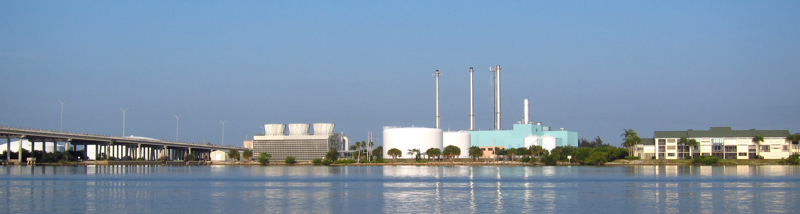
Vero Beach’s revised wholesale power contract with the Orlando Utilities Commission does not specifically require the City to decommission the power plant at the western base of the Alma Lee Loy Bridge. However, officials say the move is integral to achieving projected savings of some $52 million between now and the end of 2023.
There are four major components to the deal. Vero Beach receives lower base load rates and a contract expiration date of 2023 rather than 2029. In return, the OUC receives from Vero Beach a commitment to buy peaking power and a minimum base load.
Vero Beach’s riverfront power plant sits idle except for on the hottest and coldest days of the year, when the amount of power consumed by the 34,000 customers of Vero Electric exceeds current transmission capacity into the city. When demand exceeds transmission capacity from the OUC to Vero Beach, the power plant, affectionally known as “Big Blue,” is fired up to meet peak loads. As a part of the new agreement, Vero Beach and the OUC have arranged with Florida Power & Light to transmit additional power to the city.
Currently, “Big Blue” must be staffed twenty four hours a day, seven days a week, and the plants generators must be kept in working condition. (Last year the City spent $2 million refurbishing one of five generators.) But because “Big Blue” sits idle so much of the time, the small amount of power generated at the plant is far more expensive than the peaking power Vero Beach has agreed to buy from the OUC.
Closing the plant, officials say, will save $4 million a year in operating costs, not to mention capital costs, such as the $2 million spent last year.
Vero Beach’s projected savings over the next eight years comes from lower rates base load rates and savings in operating costs from closing the power plant, a move City officials say they hope to accomplish by Dec. 1.
By all accounts, the move will be a win-win for Vero Beach and the OUC, because the price the City will pay the OUC for peaking power will be far less than the cost of staffing and maintaining the power plant.
Everyone wins, except at least some of the employees who work at the power plant. Not all of them are likely to lose their jobs, though. Ten of “Big Blue’s” workers are eligible for retirement. Others may be qualified for open positions within the City. According to City officials, their best estimate is that no more than five power plant workers who are not yet eligible for retirement will be without work when “Big Blue” goes offline.
According to City Manager Jim O’Connor, he hopes to have the power plant offline by Dec. 1. Decommissioning the plant may not mean demolishing it, though, at least not any time soon. O’Connor said the large fuel storage tanks and external piping can soon be removed, and buyers found for the generators and cooling towers. But the building and foundation are likely to remain in place while the community goes through a process of determining how best to use the land.
Integral to that discussion are considerations about moving the waste water treatment plant to the airport. With the power plant decommissioned and the waste water treatment plant moved, Vero Beach’s waterfront could take on a very different look. Whether the land is developed exclusively for public use, or some mix of public use, retail and residential, or perhaps even a commercial marina, all options are on the table and are open for discussion. However the land is developed, Vero Beach’s riverfront will surely be more attractive than it is today.
 Indian River Guardian
The OUC contract looks better and better every day. Saving millions of dollars and eventually removing “BIG” BLUE” from the lagoon is a win now with great potential in the future. Those who voted for the OUC contract should be commended.
This is long overdue action. The current city council is to be commended, even though the decision is in the category of “no brainer.”
Bob Swift
This move on the power plant is made possible by the recently approved revisions to the City’s wholesale power agreement with the Orlando Utilities Commission, which include other benefits to the city, including lower rates, and a shortened contract term. Isn’t it interesting, then, that Pilar Turner, Harry Howle and Laura Moss opposed this agreement.