
Review
milt thomas
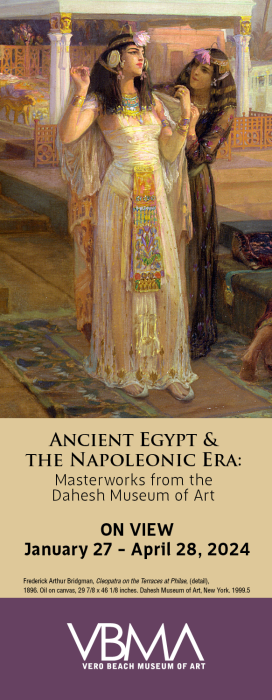
This latest exhibition at the Vero Beach Museum of Art features ancient Egypt in drawings and etchings from the first time this mystifying country was ever seen by the western world.
Imagine it is 1798. Napoleon has just invaded Egypt with an army of 55,000 that included 155 scientists – architects, engineers, zoologists, botanists – to explore and document a land that was an enigma to the outside world. No one knew how old the Egyptian civilization was because the only knowledge of it came from the ancient Greeks. Its secrets were hidden behind undecipherable hieroglyphic symbols. Egypt was not a tourist destination.
While Napoleon and his army fought to control Egypt, his scientists began investigating monuments, cities, everyday people, copying inscriptions, making notes and most importantly, drawings of what they discovered (photography did not exist). Napoleon was defeated and left in a year, but the scientists stayed on.
When they finally returned to France, they began publishing their findings between 1808 and 1828, producing eleven 100-page volumes of drawings Description de l’Égypte – the largest publication in world history. They were the very first images of Egypt ever seen in the western world and caused a sensation, including a new art movement called “orientalism.” That fascination with Egypt has lasted to this day.
A writer, Lebanese born Salim Moussa Achi, known by his pen name, Dr. Dahesh, started collecting these works of art starting in 1930 and continuing throughout the rest of his life. Today they are on display at the Dahesh Museum of Art in New York City. The Museum loaned a selection of his works to the Vero Beach Museum of Art and they are on display until April 28.
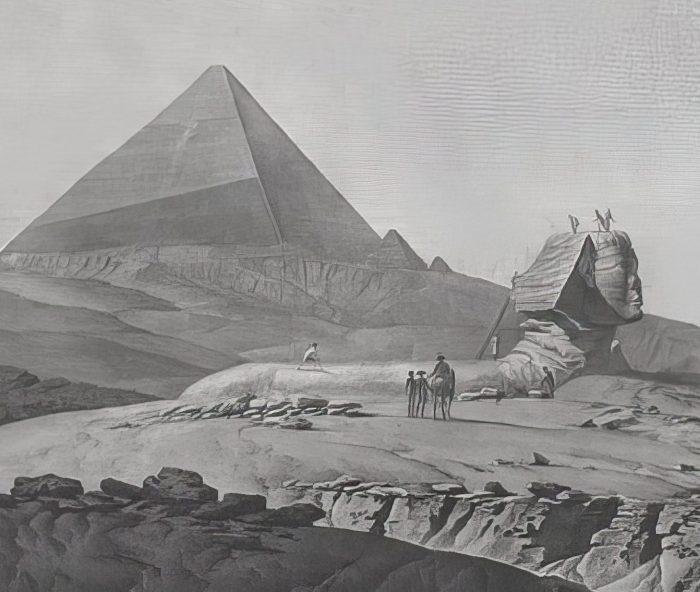

This sketch of the Great Pyramid (Cheops) and Sphinx is a section cropped from the two-page spread included in the Description de l’Égypte. At the time it was drawn, the Sphinx was partially covered by sand. The people standing on top are members of the scientific team taking measurements. All 11 volumes of this work include similar drawings of monuments, statues, hieroglyphs, people, animals and plants revealing a land once shrouded in fantasy and speculation to the outside world.
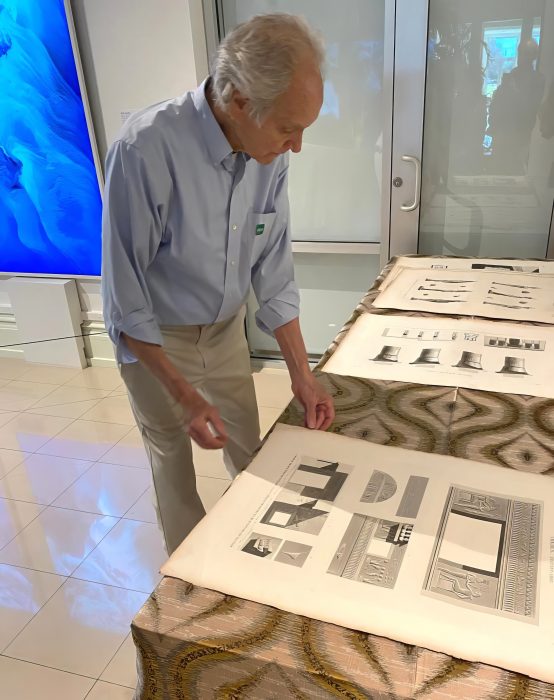
We were fortunate to have Bob Brier, a noted Egyptologist, author and TV journalist, with us as we walked through the exhibition. He was here to give a talk later that evening. In this photo, he is showing pages from the Description de l’Égypte drawn by architects on the Napoleonic mission.
The Dahesh Exhibition includes 60 drawings and paintings from the Napoleonic period and subsequent orientalism works.
The Museum will present a full slate of related programming for all age groups and interests, including International guest lectures, Art Talks in the gallery, studio art classes, and artmaking projects for families. For more information and to register for programs, please visit the website http://www.vbmuseum.org and or call (772) 231-0707 ext. 116.
A catalogue accompanies the exhibition and is available for sale now in the Museum Store.
The Vero Beach Museum of Art is located at 3001 Riverside Park Drive, Vero Beach, Florida 32963. Directions: From I-95 (Exit 147), from U.S.1, and Indian River Boulevard, take State Road 60 east over the Merrill Barber Bridge to the beachside, and turn right at the first traffic light into Riverside Park. Parking is free.
 Indian River Guardian