
news release
Before you plant that new ornamental vine, flowering shrub or tree that caught your eye, University of Florida scientists have a simple request: check this list.
In observance of National Invasive Species Awareness Week, UF researchers are urging the public to use a free website that helps Floridians avoid turning today’s landscape must-have into tomorrow’s ecological mistake.
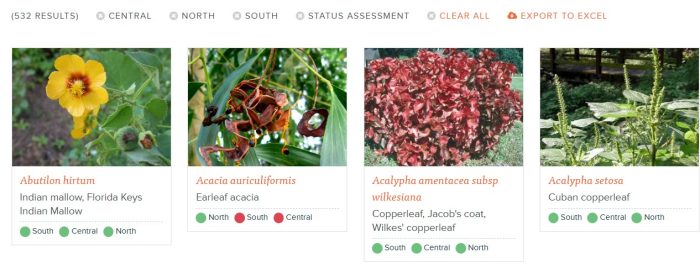
The UF/IFAS Assessment of Non-native Plants in Florida’s Natural Areas serves as a front-line defense against invasive plants. The site evaluates and categorizes non-native plant species based on their risk of invading natural and agricultural systems.
“Many non-native species are valuable as food and landscaping plants, but others should be avoided to reduce the chances that they escape and cause problems for agriculture or surrounding natural areas,” said Luke Flory, a professor and associate chair of the UF/IFAS agronomy department and director of the Invasion Science Institute (ISI) who oversees the assessment.
Don’t see your plant in the database? Users can upload a photo and submit it for a free assessment. Citizen submissions help scientists provide current, science-based recommendations for non-native plants across the Sunshine State.
“We want to prevent species from becoming invasive in Florida to begin with,” said Seokmin Kim, coordinator of the UF/IFAS assessment. “There are many non-native species out there that we need to watch out for and prioritizing high-risk plants is critical.”
Kim manages the assessment website, conducts evaluations and reassessments, oversees a small team and communicates regularly with researchers, land managers, industry representatives, Master Gardener Volunteers and the public.
The program uses peer-reviewed evaluation tools that rely on scientific literature and modeling. Climate modeling helps determine whether a species can survive and reproduce under Florida conditions. The process evaluates plants in the state, species proposed for introduction and newly developed horticultural or agricultural cultivars.
Florida’s geography makes it especially vulnerable. With more than 30 international and domestic ports of entry, millions of visitors each year and a climate that supports year-round plant growth, the state is home to at least 1,400 non-native plant species. While many coexist without issue, others outcompete native plants, disrupt wildlife habitats and create costly control efforts, added Kim.
As of 2025, the UF/IFAS assessment has evaluated 970 plant species. Of those, 344 are classified as high-risk, invasive or prohibited. The findings inform conservation strategies and support decisions about Florida’s noxious weed list, which can legally restrict the sale and distribution of harmful plants.
UF/IFAS recommends against broader use for plants identified as high risk. Agencies such as the Florida Fish and Wildlife Conservation Commission consult the website when setting management priorities.
New plant species are added almost weekly as requests come in from across the state. Moderate-risk species are reassessed every two years, while low and high-risk plants are reviewed every 10 years to ensure recommendations reflect current science.
“Almost every invasive plant was introduced to Florida by people,” said Kim. “The vast majority didn’t introduce these plants on purpose. They simply weren’t aware they could become problematic. By using resources like our website, people can make more informed decisions.”
As weather changes and global trade continue to increase the movement of species worldwide, early detection and risk assessment are essential to protecting Florida’s biodiversity, agriculture and economy.
“Prevention is always more effective than management after the fact,” said Kim. “If we can identify high-risk species early, we can help safeguard Florida’s ecosystems for generations to come and avoid costly mistakes.”
ABOUT UF/IFAS
The mission of the University of Florida Institute of Food and Agricultural Sciences (UF/IFAS) is to develop knowledge relevant to agricultural, human and natural resources and to make that knowledge available to sustain and enhance the quality of human life. With more than a dozen research facilities, 67 county Extension offices, and award-winning students and faculty in the UF College of Agricultural and Life Sciences, UF/IFAS brings science-based solutions to the state’s agricultural and natural resources industries, and all Florida residents.
 Indian River Guardian