
MILT THOMAS

The latest challenge to our all-important citrus industry has the innocuous name of “greening.” While it doesn’t sound as bad as canker or Mediterranean fruit fly, it poses the most serious threat yet to the fruit that made Florida famous.
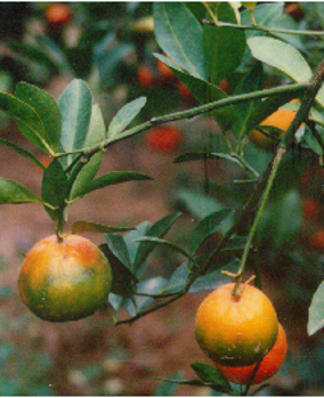
Huanglongbing is much more difficult to pronounce, but that is the scientific name for this disease. It is caused by an insect no larger than the head of a pin called the Asian citrus psyllid (sill-id). Greening has no effect on humans, but has killed millions of citrus trees here and abroad since it was first discovered in the late 1990s. It causes fruit to be misshapen, bitter to the taste and green in color instead of orange. Unlike canker, it may take up to three years to infect a tree and by then it may be too late to do anything about it. Also, there is no known cure.
With that description, it would seem that the $9 billion citrus industry and tens of thousands of jobs are lost forever, but not so, says Doug Bournique, general manager of the Indian River Citrus League in Vero Beach. “The cattle industry survived hoof and mouth disease and mad cow. We’ve survived freezes, droughts, fruit flies, nematodes and canker, all of which were thought to bring our industry to its knees.”
The reason for Bournique’s optimism is found in the U.S. Horticultural Research Laboratory in Ft. Pierce.
“Over $75 million has been spent on research and we are close to a breakthrough. They have 30 PhD’s and 120 lab technicians focused primarily on coming up with a cure. But research takes time. It’s like solving a puzzle, finding the pieces and then putting them all together.”
Bournique says the short term goal is to keep existing trees alive and of course, the jobs those trees create. To that end, he believes a visit by Governor Scott last year may have been the turning point.”He was in the area and we invited him out to a grove. He picked fruit for two hours, then drove a truck to the IMG Citrus packinghouse, packed fruit and loaded a pallet just to experience the business. He saw a green branch on one of the trees and I said these trees and the jobs they support will all disappear if we don’t find the answer. That was Friday, May 2, 2012 and he told me to be in his Tallahassee office on Monday. I was given a list of projects that showed the most promise and brought it with me. He wanted to know which short term projects he could fund to save those jobs and approved $9.6 million. It was the biggest pot of money the industry had ever seen and 85-90% was earmarked for citrus greening.”
Greening originated in China, where it is known as yellow dragon. “The psyllid attacks the tree’s circulatory system and shows up when a limb turns yellow. It has infected citrus in many countries and probably arrived here in exotic plants brought to Miami.”
It only takes one plant to infect an industry as was found when citrus canker arrived. “One woman from Southeast Asia brought a cutting from her favorite grapefruit tree in her handbag and didn’t declare it when she returned to Florida. She wanted to graft in to a tree in her backyard. Any wind 18 mph or above spreads canker. As the tree whips in the wind it spreads to nearby trees and from there advances in a cone-like pattern. When the original tree was discovered and the pattern established, growers started cutting down trees. After 90 percent of the infected trees were cut down, many in residential yards, a Judge J. Leonard Fleet signed a court order to stop the action, saying the Florida Department of Agriculture failed to meet constitutional standards for searches of private property. The disease then spread throughout Florida. Incidentally, Judge Fleet eventually moved to Vero Beach, in a region almost destroyed by his order.”
Citrus is not an industry for the faint of heart. The challenges are greater than just about any food crop. “With most crops, you know if you have a winner or a loser within months. It takes seven years before a citrus tree reaches maturity and becomes profitable. In the meantime, you risk failure from hurricanes, freezes, droughts and anything else nature throws at you. Then there is foreign competition from Brazil and Mexico. They don’t have an EPA, DEP, water management district or fish and wildlife. That is why it costs about $2400 an acre to grow citrus here.”
They do have the same diseases, although they handle them differently. “In Brazil, if canker infects a grove, they just plow it under and cut down rainforest to create new grove land. In Florida, they aren’t creating new farmland. It’s enough of a problem just maintaining the acreage we have now.”
Fortunately, foreign markets have become an important revenue source for growers of Indian River fruit. “About 80 percent of our fresh fruit crop is exported to 24 different countries. With that business comes extra burdens though for growers. Each country has different requirements and you have to know the currency exchange rate at time of shipment.”
Japan has been a major export market for years. “Japanese buyers are in here all the time inspecting groves and packinghouses. The Ocean Grill even prints their menu in Japanese. But that success is all because we have the best grapefruit in the world.”
Bournique is confident that an answer to the citrus greening problems will come. “Growers are still planting trees and that takes optimism on their part. Newer, sturdier and more resistance varieties will come from this research so at some point we can talk about greening in the past tense and green will only be known as the color of the leaves like it always has.”
 Indian River Guardian