
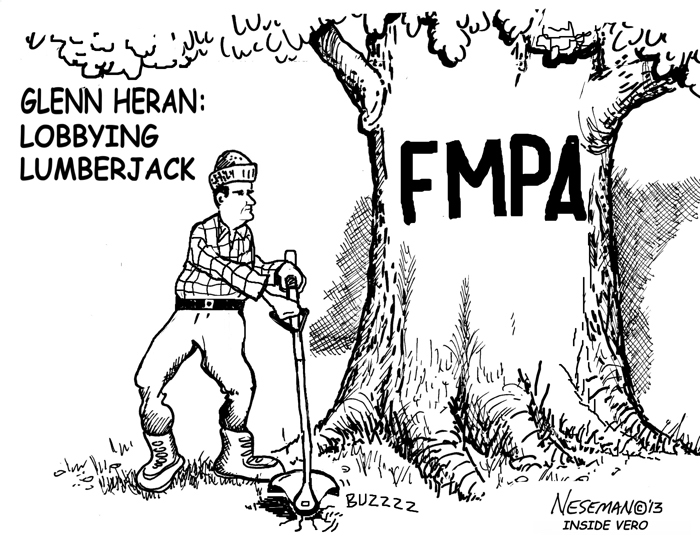
 Editor’s Note: Anyone we reads the island weekly’s current story on the status of the sale of Vero Beach’s electric utility will get another dose of tabloid bias and negativity, seasoned with misinformation. While resolving the city’s contractual obligations to the Florida Municipal Power Agency is, in fact, the remaining hurdle to be cleared, it is misleading to suggest the FMPA “stands in the way of closing the sale.”
That statement is something like suggesting gravity stands in the way of perpetual motion. Just as gravity is a law of nature that cannot be ignored without consequence, the sanctity of contractual obligations is the law of our land. Respect for and the enforcement of contracts makes commerce and free enterprise possible. And yet, there are those, including utility activist Glenn Heran and the editors and reporters at the island weekly, who seek to demonize the FMPA for protecting the legitimate interests of its member cities and customers, as well as its creditors.
It is also a stretch to describe the FMPA’s response to Florida Power & Light President Eric Silagy’s latest proposal as “demands,” just as it is inaccurate to insist the only way to conclude the deal is for the FMPA to assume Vero Beach’s power entitlements for the first three years following the sale. As the story below, first posted Dec. 12, explains, if FPL’s negotiators cannot live with the FMPA’s terms, they can always negotiate with the Orlando Utilities Commission to assume those power entitlements. Should the OUC want more than the FMPA is asking, then it will indeed be a stretch to accuse the FMPA of “standing in the way of the sale.”
MARK SCHUMANN


Florida Municipal Power Agency General Manager and C.E.O., Nick Guarriello, told members of the FMPA All Requirements Project Executive Committee today he expects to present a draft response to Florida Power & Light at the FMPA’s January 23 board meeting.
The board will be given a projected cost for assuming Vero Beach’s power entitlements and debt obligations on the Stantion I and Stantion II coal-fired plants in Orlando, as well as a rational for the number. The FMPA board could then vote on the deal at its February 19 meeting.
Both the projected cost and the supporting analysis will be made public by mid January, and has likely already been communicated to FPL.
FPL spokeswoman Sarah Gatewood was quoted in a local press report as saying the company has received a response to its August proposal to the FMPA. “FPL is evaluating the response we received from FMPA on the solution that we proposed to allow Vero Beach to exit its contractual obligations. We will follow up with the FMPA, the City, and the community once we have completed our evaluation,” Gatewood reportedly wrote in an email.
In an effort to move forward stalled negotiations, FPL President and C.E.O., Eric Silagy, wrote Guarriello in August offering to pay the FMPA to assume Vero Beach’s Stanton I and Stanton II obligations for three years. Silagy’s proposal left open the price to be paid. (See: FPL puts new deal on the table)
Silagy’s August proposal, which has become knows as “Plan B,” replaced an earlier agreement between Vero Beach, the Orlando Utilities Commission and FPL in which the OUC was to assume Vero Beach’s position in three FMPA power projects – the Stanton I, Stanton II generators and the St. Lucie Two nuclear plant.
The OUC was to sell the Stanton I and Stanton II power to FPL for three years, after which it was to assume Vero Beach’s obligations in exchange for $34 million in cash and the assignment of the city’s gas transmission rights, valued at $8 million to $10 million. The OUC is to be paid an additional $20 million in liquidated damages for canceling a separate 20-year wholesale power contract it has with Vero Beach.
For more than a year before Vero Beach, FPL and the OUC signed the power purchase agreement, FMPA officials cautioned the plan would almost surely run afoul of Internal Revenue Service restrictions and would thus put at risk the tax exempt status of FMPA bonds.
Last summer, when it finally became clear to negotiators for Vero Beach and FPL that the IRS would likely not approve the sale of FMPA power to an investor owned utility, Silagy proposed “Plan B.”
Claims that the fate of the deal rests solely with the FMPA are not completely accurate. Should FPL reject the FMPA’s number, it can attempt to negotiate a price at which the OUC would retain Vero Beach’s Stantion I and Stanton II power for the first three years.
Regardless of who takes on Vero Beach’s position in the three FMPA power projects, the city will remain contingently liable for its share of the bond obligations. To cover this liability, Vero Beach will have to pledge its electric utility tax and franchise fee revenue.
Silagy’s August letter also proposed that, as a part of the agreement, the FMPA board would give Vero Beach a waiver allowing the city to withdraw from the All Requirements Project before September 30, 2016.
Because ARP membership contracts require each and every member to approve changes to the agreements, Vero Beach’s request for a waiver will have to be approved by all 16 member cities. To allow for the prospect that Vero Beach might not receive the waiver it seeks, the purchase and sale agreement between Vero Beach and FPL provides for a closing of as late as Dec. 31, 2016.
Impatient with the pace of the negotiations, and frustrated their constituents may have to wait until 2017 for lower rates, the Indian River County Commission and the Indian River Shores Town Council recently agreed to cooperate in a lobbying effort to persuade the Florida Legislature to put pressure on the FMPA. Neither or the two bills they plan to push address Vero Beach’s membership in the FMPA’s ARP, though, so it seem unlikely a sale of Vero Beach’s electric utility is possible before late 2016.
Utility activists Glenn Heran, Dr. Stephen Faherty, along with state Rep. Debbie Mayfield, have recently made public statements suggesting it is time to “fight” the FMPA. If it turns out the OUC wants more than the FMPA for assuming Vero Beach’s power entitlements, it may prove difficult for Mayfield and others to continue insisting the agency is being unreasonable.


“Should FPL reject the FMPA’s number, it can always go back to the OUC and attempt negotiate a price at which the OUC would retain Vero Beach’s Stanton I and Stanton II power for the first three years.”
What happens after three years? Who will take on Vero beach’s liability after three years – what are other related costs?
When will the proposal go before the member cities?
The OUC has agreed to assume Vero Beach’s FMPA power entitlements/obligations after the first three years, and would take on the St. Lucie nuclear power from day one. It is only the Stanton I and Stanton II power they they do not want to assume until after the first three year.