
News release
Editor’s note: Upgraded Points is a travel website that teaches travelers how to maximize frequent flyer miles and loyalty points. https://upgradedpoints.com/news/airports-airlines-most-july-fourth-flight-delays/
Few travel periods are busier — or more delay-prone — than the Fourth of July holiday. Millions of Americans take to the skies each year, putting added strain on airports and airlines during an already hectic summer travel season.
Packed flight schedules, severe summer storms, and increased air traffic can quickly turn holiday travel into hours spent waiting at the gate. While delays can happen anywhere, some airports and airlines experience them far more often during the July Fourth rush.
Using on-time performance data from the Bureau of Transportation Statistics (BTS), we analyzed flights during the BTS-defined July Fourth holiday travel periods from 2023 through 2025 to identify the U.S. airports and airlines with the highest rates of delayed departures and arrivals. Our analysis focused on the 60 largest U.S. airports and 9 major airlines, ranking each by the percentage of flights delayed by 15 minutes or more.
Keep reading to see which airports and airlines are most likely to test travelers’ patience during one of America’s busiest holiday travel periods.
Key Takeaways
- Orlando International Airport (MCO) ranks as the U.S. airport with the most July Fourth delays, with 34.6% of flights delayed between 2023 and 2025.
- JetBlue Airways is the airline most prone to July Fourth departure delays, with 34.1% of flights departing late during the study period.
- Florida dominates the rankings for holiday delays, with Orlando, Fort Lauderdale (FLL), Tampa (TPA), Palm Beach (PBI), Jacksonville (JAX), and Miami (MIA) all appearing among the worst-performing airports.
- Hawaiian Airlines had the fewest July Fourth departure delays among major U.S. airlines, with just 11.9% of flights delayed.
- Airports in Hawaii, Alaska, and the Pacific Northwest generally experienced the smoothest July Fourth travel performance.
- July Fourth delay rates were significantly higher than normal operational averages (25.6% vs. 20.8%), highlighting the strain holiday congestion places on U.S. air travel systems.
When it comes to July Fourth travel, not all airlines perform equally. To identify which carriers struggle most during the July Fourth travel period, we analyzed departure and arrival delays across 9 major U.S. airlines during the BTS-defined holiday windows from 2023 through 2025.
Departures
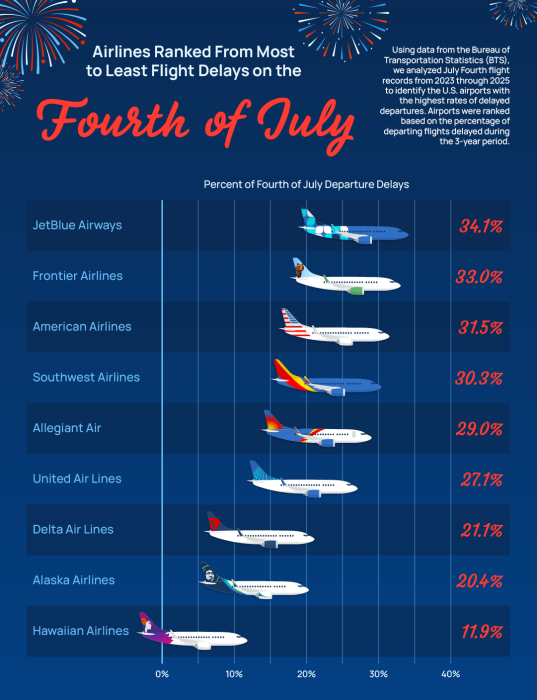
Based on our analysis, JetBlue ranks as the airline most prone to delayed departures on July Fourth, with 34.1% of flights departing late during the 3-year study period.
Frontier Airlines follows closely behind at 33.0%, while American Airlines rounds out the top 3 at 31.5%. Southwest Airlines (30.3%) and Allegiant Air (29.0%) also posted notably high July Fourth departure delay rates.
Several of the airlines near the top of the rankings operate extensive networks in Florida and the Northeast — 2 regions especially vulnerable to summer thunderstorms and heavy holiday travel demand. JetBlue, for example, maintains large operations in delay-prone airports such as New York (JFK), Boston (BOS), and Fort Lauderdale (FLL), all extremely popular vacation destinations for holiday travel, fireworks shows, and sightseeing.
Meanwhile, Frontier and Allegiant rely heavily on leisure routes and secondary airports, where tighter aircraft scheduling and fewer backup resources can make recovery from disruptions more difficult during busy travel days.
On the opposite end of the rankings, Hawaiian Airlines stands out as the airline least likely to experience July Fourth departure delays, with just 11.9% of flights delayed. Alaska Airlines (20.4%) and Delta Air Lines (21.1%) also performed relatively well compared to other carriers.
Delta’s lower delay rate is particularly notable given the size of its operation. The airline has consistently ranked among the better-performing U.S. carriers for operational reliability, thanks in part to strong network recovery systems and schedule flexibility.
Arrivals
The rankings for delayed arrivals closely mirror departure trends.
Frontier ranks as the airline most likely to experience delayed arrivals on July Fourth, with 34.5% of flights arriving late. JetBlue follows closely behind at 34.3%, while American again ranks third at 31.8%.
One noticeable trend is the consistency between departure and arrival performance. Airlines with high departure delay rates also tended to struggle with arrivals, highlighting how disruptions earlier in the day often cascade throughout an airline’s network.
Allegiant (31.3%), United (27.8%), and Southwest (27.1%) also posted elevated arrival delay rates during the holiday period.
Meanwhile, Hawaiian Airlines once again ranks as the airline least prone to delays, with just 12.9% of July Fourth arrivals delayed. Delta (20.7%) and Alaska (21.9%) also maintained comparatively smooth operations.Bottom Line:
Overall, July Fourth flight delays were significantly higher than national averages across several major U.S. airlines. Carriers with large leisure travel networks and operations concentrated in weather-sensitive regions tended to perform the worst, while airlines with stronger operational resilience and less congested route systems generally fared better.
Airports can experience vastly different levels of disruption during peak travel periods, especially during the busy Fourth of July holiday. To see where travelers are most likely to encounter delays, we analyzed departure and arrival performance across America’s 60 largest airports from 2023 through 2025.
Departures
Orlando International Airport (MCO) ranked highest for delayed departures on July Fourth, with 34.6% of flights departing late during the study period.
Fort Lauderdale-Hollywood International Airport (FLL) follows closely behind at 33.0%, while Louis Armstrong New Orleans International Airport (MSY) ranks third at 32.6%.
Rounding out the top 10 airports with the most delayed July Fourth departures are:
- Tampa International Airport (TPA): 32.4%
- Jacksonville International Airport (JAX): 30.9%
- Bradley International Airport (BDL): 30.7%
- San Antonio International Airport (SAT): 30.3%
- Palm Beach International Airport (PBI): 30.2%
- Pittsburgh International Airport (PIT): 30.0%
- General Mitchell International Airport (MKE): 29.9%
One of the clearest patterns in the data is the dominance of Florida airports. Four of the top 10 airports with the most delayed July Fourth departures are located in the Sunshine State, including Orlando (MCO), Fort Lauderdale (FLL), Tampa (TPA), and Palm Beach (PBI).
Florida’s combination of intense summer thunderstorms, high humidity, and massive holiday tourism demand likely contributes to the elevated delay rates. Orlando (MCO), in particular, serves as one of the nation’s busiest leisure travel hubs during the summer, placing additional pressure on airport operations during peak holiday periods.
New Orleans (MSY) also stands near the top of the rankings, likely due to a combination of Gulf Coast weather disruptions and strong seasonal tourism.
Interestingly, several airports on the list — including Hartford (BDL) and Pittsburgh (PIT) — are not among the nation’s busiest hubs overall. This suggests that even midsized airports can experience significant holiday disruptions when weather and congestion coincide.
U.S. Airports With the Fewest July Fourth Departure Delays
While some airports struggle with heavy Independence Day congestion, others keep flights moving relatively smoothly.
Among the airports with the lowest percentage of delayed July Fourth departures were:
- Daniel K. Inouye International Airport (HNL)
- Kahului Airport (OGG)
- Portland International Airport (PDX)
- Boise Airport (BOI)
- Ted Stevens Anchorage International Airport (ANC)
Many of these airports benefit from lower congestion, fewer connecting passengers, and less exposure to severe summer thunderstorms than major East Coast and Southern airports.
Hawaii airports, in particular, consistently performed well throughout the analysis. Despite handling large numbers of tourists, Honolulu (HNL) and Maui (OGG) tend to experience more stable weather conditions and less airspace congestion than mainland vacation hubs.
Arrivals
Arrival delays paint a similarly challenging picture for several major U.S. airports. The top 10 airports with the highest percentage of delayed July Fourth arrivals are:
- Orlando International Airport (MCO): 38.0%
- Miami International Airport (MIA): 37.9%
- Baltimore/Washington International Airport (BWI): 36.1%
- Fort Lauderdale-Hollywood International Airport (FLL): 34.7%
- Dallas Fort Worth International Airport (DFW): 32.8%
- Newark Liberty International Airport (EWR): 32.5%
- Charlotte Douglas International Airport (CLT): 32.1%
- George Bush Intercontinental Airport (IAH): 32.1%
- Philadelphia International Airport (PHL): 31.7%
- Palm Beach International Airport (PBI): 31.3%
Unlike the departure rankings, the arrival delay list is dominated by large connecting hubs. These airports serve as major airline hubs, meaning disruptions in one part of the country can quickly ripple through the system.
Florida airports once again appear prominently throughout the rankings, reinforcing the outsized impact summer weather and tourism demand have on holiday travel performance.
The high arrival delay rate at Baltimore (BWI) is particularly notable given its comparatively lower overall annual delay rate. This suggests July Fourth travel may create outsized operational strain at the airport relative to other times of the year.Bottom Line:
July Fourth travel delays have been heavily concentrated in the South and along the East Coast, particularly in Florida. Airports serving large numbers of leisure travelers and connecting passengers appeared especially vulnerable to summer weather disruptions and holiday congestion.

